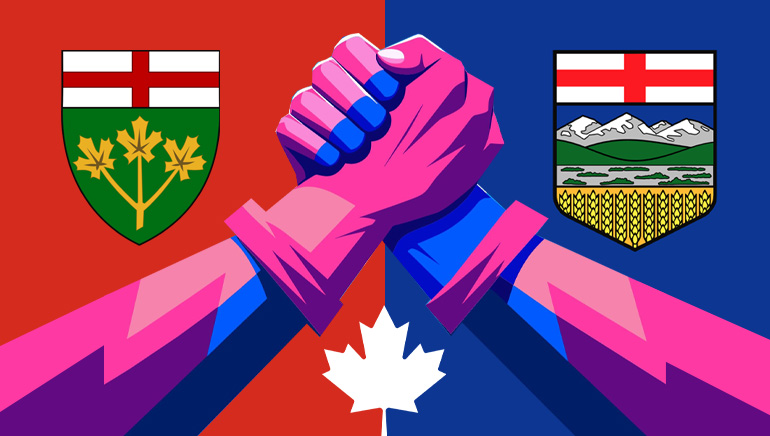
The hopes for a gambling regulation framework in Alberta in 2024 has been pushed back to 2025, resulting in a delay in reigning in the grey market. Alberta is pinning its hopes on mirroring an Ontario-style success story.
An Alberta government spokesman has confirmed that the expanded Ontario-style iGaming market in the Canadian province of Alberta has been pushed back to sometime in 2025.
Ontario, Canada’s most populous province, introduced an open, regulated iGaming market in April 2022. According to iGaming Ontario, 51 operators and 83 gaming websites are currently licensed and operating.
Alberta was seen as quickly moving towards a similar regulatory regime, but the timing of when that market will go live is now unknown.
Currently, the Alberta Gaming, Liquor and Cannabis platform’s only site that players can visit to gamble legally in the province is Play Alberta. According to the AGLC, Play Alberta, launched in late 2020, has over 313,000 registered player accounts and generated $1.91 billion in 2023.
Alberta's only regulated and legal online gambling website offers online slots, blackjack, roulette, live dealer table games, and sports betting on PC and popular mobile devices.
According to H2 Gambling Capital, which conducted the research for AGLC, it has also captured over 45% of the province's overall iGaming market. Alberta still has an active market of illegal online gambling sites.
Brandon Aboultaif, spokesman for Dale Nally, Minister of Service Alberta and Red Tape Reduction, stated:
“As the gaming industry continues to evolve globally and in Alberta, we want to ensure a conducive business environment while protecting the health and safety of Albertans, particularly our youth.”
He went on to say:
“We want to get our iGaming strategy right to ensure fairness and transparency for everyone. Gambling industry stakeholders have told us that we need to continue our conversations so they can provide more input on the model. We are doing just that. Further engagements will also bring opportunities that align with our red tape reduction policies.”
Industry reports said that a presentation to Premier Danielle Smith’s cabinet about a new iGaming regulatory regime was met with concerns and was shot down on more than one occasion.
One issue was the proposal to whitelist or grant approval to any operator already registered in Ontario who wanted to do business in Alberta as well.
The other issue debated was a proposed 25% tax rate on gambling sites’ revenues in Alberta. The province takes 20% of revenues in Ontario, and many in the industry think a tax rate higher than Ontario’s will negatively impact channelisation.
A balance must be struck to ensure the tax rate is appealing enough to encourage operators to enter Alberta’s market while also generating significant revenue for the province.
Channelisation has been very successful in Ontario. According to an Ipsos study in February 2024, the channelisation rate in Ontario stood at 84.6%.
The concept of channelisation, or channelling rate, refers to the proportion of domestic consumers within the national, or in the case of Alberta, provincial licensing system.
For several reasons, namely consumer protection, tax collection and most importantly, quality standards, the optimal channelisation rate is considered to be above 80%.
Channelisation will be an evolving process in a province with the licensing system in its early stages, such as Alberta. It takes time to get the puzzle right, as gambling regulations impose safety norms, technical standards, financial standards, and more. Still, it is easy to justify why legitimate gambling is safer and better controlled than offshore websites.
Most importantly, channelisation targets should take into account player needs. Gamblers need just enough regulation to be protected, but with excessive limitations to their gaming experience, many could be driven to unlicensed platforms.
Play Alberta may be the only regulated online gambling website in Alberta, but that doesn’t mean players are sticking to the AGLC-run option. Players can place bets with offshore gambling websites such as Bet365 and Bodog in the so-called “grey market.”
With an eye on bringing grey market bets back within provincial boundaries, Ontario became the first province in Canada to move ahead with a regulated sports betting program in 2022, allowing multiple partners to provide gambling services.
According to a report by Ontario iGaming, the province brought in $1.48 billion in total gaming revenues after the first year of that arrangement.
Service Alberta and Red Tape Reduction Minister Dale Nally said Alberta is looking to Ontario to mirror its regulatory framework around online gambling and added that the ultimate goal was to eliminate the illicit market. The best way to do that was to have a healthy, regulated market for operators and players to visit.


 Blackjack
 Roulette
 Slots
Slots Video Poker
 Baccarat
 Poker
Poker